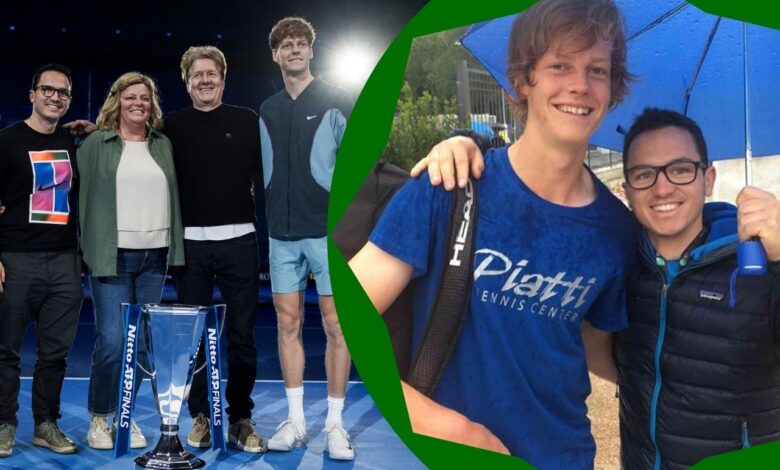
Hanspeter Sinner is a name that would have meant very little to the global sporting world just a few years ago. Today, however, it is spoken with warmth and admiration in tennis circles across every continent. Known primarily as the father of Jannik Sinner — the Italian World No. 1 tennis sensation who has taken the sport by storm — Hanspeter represents something rare in the often theatrical world of professional sports: a parent who chose quiet strength over the spotlight, and whose steady influence quietly shaped one of the most composed and disciplined champions the game has ever seen. This article explores everything that is publicly known about Hanspeter Sinner — his origins, his culture, his career, his family, and the profound but understated role he has played in producing a world-class athlete.
The Alpine Roots: A Life Shaped by South Tyrol
To understand Hanspeter Sinner, one must first understand the place that made him. South Tyrol is a mountainous autonomous province in the far north of Italy, nestled between the Dolomites and the Austrian border. It is a region unlike any other in Italy — a land of jagged Alpine peaks, dense pine forests, and valley villages where life moves with the rhythm of the seasons. The culture here is uniquely bilingual and bicultural: residents are officially Italian citizens, yet the dominant language spoken at home and in the community is German. Austrian and Tyrolean traditions run deep, from the architecture to the cuisine to the work ethic that defines daily life.
Hanspeter was born and raised in this environment. His very name, “Hanspeter,” is a compound Germanic first name — a fusion of “Hans” (a derivative of Johann) and “Peter” — that is common across Alpine Germany, Austria, and South Tyrol. This name alone speaks volumes about the cultural identity of the Sinner family. In various media reports, Hanspeter is also referred to as Johann Sinner, the more formal variant of the same name. The family’s hometown is Innichen, known in Italian as San Candido — a small, picturesque town in the Val Pusteria (Puster Valley), a region famous for its ski resorts, clear mountain air, and close-knit communities. Population figures for San Candido hover around 3,000 people, which gives a strong sense of just how modest and grounded the environment was in which Jannik Sinner’s father grew up and later raised his own children.
The culture of South Tyrol is one of industriousness, discipline, and respect for tradition. Skiing is not merely a sport here — it is a way of life. Hiking trails connect villages across the valleys, and hospitality tourism has been the economic backbone of the region for generations. Growing up immersed in these values, Hanspeter absorbed a worldview that prized hard work, honesty, and humility over ambition and celebrity. These principles would eventually become the invisible pillars of how he parented his sons and supported Jannik’s ascent to the peak of world tennis.
A Career in the Mountains: The Hospitality Life
Hanspeter Sinner did not become a professional athlete, though the mountains of South Tyrol certainly offered every opportunity for a young person passionate about winter sports to try. He channelled his working life instead into the hospitality industry, spending years employed as a chef at a ski lodge. More specifically, he worked at the Talschlusshutte Hut, a mountain lodge in Sexten — a neighboring municipality in the Val Pusteria that sits at the foot of the stunning Sesto Dolomites. His wife, Siglinde, worked at the same establishment as a waitress, meaning the entire foundation of the Sinner household was built on the honest, physical labor of mountain hospitality.
Working as a chef in a ski lodge is not a glamorous profession, but it is one that demands tremendous precision, reliability, and resilience. Mountain lodges in the Alps serve guests across grueling winter seasons, often operating in remote locations with challenging logistics. A chef in such an environment must be organized, efficient, and deeply attentive to quality — traits that require the same kind of mental discipline one sees in elite athletes. It is not difficult to trace a line between Hanspeter’s professional life and the extraordinary focus and composure that Jannik Sinner would later display on the tennis court against the world’s best players under the most intense pressure imaginable.
The hospitality world of South Tyrol also means that Hanspeter would have been surrounded throughout his career by people from many walks of life — tourists from across Europe and the world who visited the Val Pusteria for skiing and hiking. This exposure to diverse people and cultures within the context of a proudly regional identity may have helped broaden the family’s perspective, even as they remained deeply rooted in their Alpine home. There is no record of Hanspeter pursuing celebrity, wealth, or a career change. He appears to have found deep satisfaction in his craft and his community, and passed that contentment on to his sons.
Meeting Siglinde: A Love Story Born in the Alps
The story of how Hanspeter Sinner met his wife Siglinde is a detail that has charmed fans around the world and speaks beautifully to the authenticity of their family story. The couple met at a ski lodge — the very kind of Alpine hospitality establishment where they would both later build their careers. There is something deeply fitting about this: two people from the same community, sharing the same environment, finding one another in the warmth of a mountain lodge while the snow fell outside. It is an origin story that belongs to the landscape of South Tyrol as much as the Dolomites themselves.
Siglinde Sinner is, in her own right, a figure of quiet admiration among tennis fans who have come to know the Sinner family through Jannik’s televised matches. She is frequently seen in the player’s box during Jannik’s biggest matches, and her emotional reactions — eyes wide with tension, hands clasped, visibly holding her breath during key moments — have gone viral on social media multiple times. She has become something of an icon among fans who appreciate the authentic human drama of parents watching their child compete on the world stage. In stark contrast, Hanspeter sits beside her as the picture of calm — composed, watchful, measured. Jannik himself has noted this contrast with great affection, saying: “My mom is very stressed and my dad’s very calm.” The dynamic is both endearing and telling — it reflects how their individual personalities complemented each other in raising a mentally formidable champion.
Together, Hanspeter and Siglinde have two sons. Marc Sinner, the elder of the two, has lived a much more private life than his younger brother. Jannik Sinner, born on August 16, 2001, would go on to become the focal point of global attention. But the family unit — grounded in the modest, hardworking life of the Val Pusteria — remained constant and close throughout Jannik’s meteoric rise. The couple’s relationship is a model of the kind of stable, supportive partnership that allows children to develop without anxiety, and Jannik has spoken warmly of his parents on many occasions, describing them as “wonderful, wonderful parents” who gave him the freedom to find his own path.
Raising a Champion: The Philosophy of Freedom and Support
One of the most frequently cited aspects of Hanspeter Sinner’s parenting is the philosophy of freedom he and Siglinde applied to their sons’ upbringing. In a world where sports parenting often defaults to intense pressure, early specialization, and relentless performance targets, the Sinner household was notably different. Jannik was allowed to explore multiple sports as a child without any particular one being imposed upon him. He tried skiing — naturally, given South Tyrol’s culture — and showed genuine promise, becoming a nationally ranked junior skier before his teen years. He also played football and engaged in other activities typical of Alpine youth.
Hanspeter’s initial sporting passion was skiing, and there was a period in his own life when he contemplated whether to pursue it seriously. That personal experience of weighing athletic potential against practical reality gave him a nuanced perspective when it came to guiding his own son. Rather than projecting his own unfinished ambitions onto Jannik — a common pitfall for athletic parents — Hanspeter appeared to genuinely observe his son’s talents and inclinations before making any recommendations. When it became clear that tennis offered Jannik a broader platform for competitive growth, Hanspeter encouraged the switch — but crucially, the decision remained Jannik’s own.
This hands-off yet attentive approach to parenting is reflected in comments Jannik has made in numerous interviews. “They never put pressure on me,” he told reporters after one of his early ATP victories. “I wish that this freedom is possible for as many young kids as possible.” That statement, made by a young man who had just beaten one of the world’s best players, speaks volumes about how deeply the Sinner family’s parenting philosophy had shaped his character. Jannik did not feel the need to win for his parents — he wanted to win for himself. That internal motivation, rather than external pressure, is widely considered by sports psychologists to be one of the most reliable predictors of sustained athletic excellence.
The Pivotal Decision: Letting Jannik Leave Home at 13
Perhaps the most defining moment in Hanspeter Sinner’s role as a father came when Jannik was approximately 13 years old. It was at this age that the young Jannik made the decision to leave his family home in San Candido and relocate to Bordighera, on the Italian Riviera, to train full-time under the renowned coach Riccardo Piatti. Piatti had previously coached players like Ivan Ljubičić and Milos Raonic, and his academy was considered one of the most serious tennis environments in Europe. For a 13-year-old boy from a small Alpine town to move hundreds of kilometers away from his family to pursue a dream was an extraordinary step — and it required his parents’ blessing.
The decision to let a child leave home at such a young age is never taken lightly. The emotional and practical weight of such a choice falls on parents as much as on the child. Hanspeter and Siglinde faced the reality of watching their younger son move away while still in his early teens, trusting that he had the maturity and resilience to thrive far from the familiar comforts of the Val Pusteria. That trust — placed not just in Jannik but in the environment they had created — proved well-founded. Jannik Sinner would go on to become one of the most mentally robust tennis players of his generation, famously immune to the kind of emotional volatility that derails so many young athletes.
Jannik has spoken in interviews about how much time he has spent away from his parents since the age of 14, acknowledging that it is more than most players experience. Yet rather than framing this with sadness or resentment, he speaks of it with gratitude and perspective — cherishing the moments they do share, understanding that the distance was a necessary part of his journey, and knowing that his parents’ support never wavered even from afar. The willingness to make that sacrifice, both as parents and as a young athlete, is one of the quiet stories behind one of modern tennis’s great success stories.
Hanspeter on Tour: The Travelling Chef and Family Anchor
As Jannik Sinner’s career progressed and the tournaments grew bigger and the stakes higher, Hanspeter did not simply remain at home in South Tyrol. He began accompanying his son on portions of the ATP Tour, becoming a regular presence in Jannik’s team environment during major events. His role, characteristically, was a practical and personal one: according to multiple reports, Hanspeter has served as a de facto family chef during tournaments, preparing familiar meals that help Jannik maintain nutritional consistency and emotional comfort while traveling through different countries and time zones.
This contribution, though unglamorous, is genuinely significant. The challenge of maintaining optimal nutrition and physical readiness across the relentless schedule of the ATP Tour is immense. Players cycle through cities, hotels, climates, and cuisines at a pace that would disorient most people. Having a trusted family member on hand to prepare food that feels like home — the flavors and cooking of South Tyrol — provides a thread of continuity in an otherwise disorienting environment. It is the kind of support that does not make headlines but contributes materially to a player’s performance and wellbeing.
Beyond the practical, Hanspeter’s presence on tour provides something less tangible but equally important: the emotional grounding of family. Jannik Sinner is well known for his extraordinary calm on the court — a composure that has earned him the nickname “The Ice Man” in some quarters of the tennis world. That calm does not emerge from nowhere. It is cultivated through years of practice, mental training, and — crucially — the security of knowing that people who love you unconditionally are close by. Hanspeter’s quiet presence in the player’s box, watching with that characteristic stillness while Siglinde fidgets nervously beside him, is itself a kind of anchor for Jannik. It is the familiar calm of home, replicated in the most pressurized arenas in the world.
Shared Moments: From the ATP Finals to the Golf Course
The relationship between Hanspeter and Jannik Sinner is not purely defined by the serious business of professional tennis. There are numerous documented moments of simple, joyful father-son connection that have captured the public’s imagination. One of the most significant of these came in November 2024, when Jannik won the Nitto ATP Finals in Turin — one of the most prestigious end-of-season events in the sport. After defeating American Taylor Fritz in the final, Jannik was photographed celebrating alongside his father Hanspeter. The image of the two together — the composed Alpine chef and his champion son — became one of the most widely shared sports images of the year. It was a moment that distilled everything moving about the Sinner family story: a man who had spent decades working in mountain lodges, watching his son triumph on the biggest stage in tennis.
Around the same period, Jannik and Hanspeter were filmed together on a golf course during one of Jannik’s off-season breaks, with coach Darren Cahill capturing the footage. Jannik, who is a supreme athlete when a tennis racket is in his hand, attempted a golf swing — and produced a hilariously mis-timed effort that barely made contact with the ball. Both father and son dissolved into laughter, the footage showing a side of Jannik that his steely on-court demeanor rarely hints at: a young man who can laugh at himself with ease, especially in the company of his father. The moment went viral, and fans responded with enormous warmth to its naturalness and charm.
Earlier, during the 2024 BNP Paribas Open at Indian Wells, Hanspeter was spotted joining Jannik and the broader team for an impromptu football session on a practice court between training sets. These casual, playful scenes of father and son kicking a ball around, sharing a laugh, and staying connected amid the demands of professional tennis speak to a relationship that has never lost its humanity despite the extraordinary circumstances surrounding it. Jannik has always been clear that moments with his family — however infrequent — are among the most treasured of his life on tour.
A Cultural Identity Written in Two Languages
One of the most distinctive aspects of Hanspeter Sinner’s identity — and by extension, the Sinner family’s identity — is its dual linguistic and cultural character. South Tyrol’s bilingualism means that the Sinner family almost certainly speaks German as their primary home language, while also being fluent in Italian as citizens of the Italian Republic. This unusual combination of Austrian-Germanic culture and Italian national identity creates a distinctive worldview that is neither purely one nor the other, but something uniquely Tyrolean.
For Jannik, this background has had a visible effect. He gives interviews fluently in Italian, German, and English — a trilingual capability that is partly the product of his elite tennis education but is also rooted in the multilingual household in which he grew up. He carries himself with a combination of the disciplined, reserved quality associated with Alpine Germanic culture and the warmth and expressiveness more typically associated with Italian culture. The result is a personality that reads as genuinely unusual on the ATP Tour: serious and focused, but never cold; warm but never showy; proud of his Italian identity while deeply connected to the German-speaking heritage of South Tyrol.
Hanspeter’s own identity reflects this same duality. His name is Germanic; his nationality is Italian; his home is Alpine. He occupies a cultural space that many outsiders find difficult to categorize, and that is precisely what makes the Sinner family so interesting. They belong neither entirely to the Italian sporting tradition nor to the Austrian one. They are South Tyrolean — a distinct identity unto itself — and that particularity of place and culture has left its mark on every aspect of how Jannik Sinner carries himself as an athlete and a human being.
Life Away from the Camera: Privacy as a Principle
Perhaps the most consistent and defining characteristic of Hanspeter Sinner as a public figure — insofar as he can be called one — is his deliberate, principled privacy. In an era when the parents of celebrity athletes routinely seek their own platforms, television appearances, and social media profiles, Hanspeter has done the opposite. He has no known public social media presence. He does not give regular interviews. He does not comment publicly on Jannik’s matches, his son’s coaching team, or the controversies that inevitably swirl around any elite athlete. He appears at tournaments when his schedule allows, watches from the player’s box with quiet intensity, and then returns to his life in South Tyrol when the tournament ends.
This privacy is not avoidance — it is a philosophy. Hanspeter’s life story suggests a man who has always found meaning in doing rather than being seen to do. He cooked meals in a mountain lodge not for recognition but because it was his craft and his contribution. He supported his son’s move to a tennis academy not for reflected glory but because he believed in the decision. He traveled to tournaments not for press attention but to be present for his child. In each case, the motivation is the thing itself, not the audience watching it. That orientation — internal rather than external — is one of the most powerful things a parent can model for a child, and Jannik’s own remarkable immunity to the ego-driven pressures of elite sport suggests the lesson was well learned.
The broader tennis public has responded to this family dynamic with almost universal admiration. In a world where pushy sports parents have become something of a cliché — figures who manage their children’s careers with an aggressive visibility that can cross into exploitation — the Sinners represent something refreshingly different. Their presence is felt as support, not pressure. Their involvement is loving, not controlling. And Hanspeter’s particular brand of quiet strength has made him one of the most beloved parental figures in the tennis world without him ever having sought that status.
The Values He Passed On: Discipline, Calm, and Work Ethic
When tennis commentators and analysts seek to explain Jannik Sinner’s extraordinary mental fortitude — his ability to remain composed during five-set Grand Slam battles, his refusal to become distracted by controversy, his methodical approach to improvement — they often point to his coaching team and his natural talent. But the foundation beneath all of that was laid long before any coach got involved. It was built in the kitchen of a ski lodge in Sexten, in the dining room of a modest family home in San Candido, and in the patient, principled parenting of Hanspeter and Siglinde Sinner.
The discipline Hanspeter brought to his work as a chef — the precision, the consistency, the commitment to quality under pressure — is mirrored almost exactly in the way Jannik approaches his tennis. The calm that Hanspeter displays in the player’s box, even as match points hang in the balance, is the same calm that Jannik channels when serving for a championship at a Grand Slam. The work ethic of a man who spent decades in the demanding world of Alpine hospitality is the same work ethic that drives Jannik through grueling pre-season training camps and long hours on the practice court. These are not coincidences. They are the inheritance of a son who watched his father closely and absorbed what he saw.
Hanspeter’s influence on Jannik’s personality is perhaps most evident in moments of defeat and setback. When Jannik loses — which, like any athlete, he does — he does not dissolve into visible distress or blame others. He analyzes, accepts, and moves forward. This response pattern, so unusual in elite sport, is a direct reflection of the grounded, realistic worldview that life in South Tyrol and the example of his father instilled in him. There is a maturity in Jannik Sinner that seems well beyond his years, and it is inseparable from the quiet, steady example set by Hanspeter Sinner across the entirety of his son’s life.
The World Discovers Hanspeter: Viral Fame and Fan Affection
It was, in many ways, inevitable that the world would eventually turn its attention to the man behind the champion. As Jannik Sinner’s victories multiplied — the 2024 Australian Open, the 2024 US Open, three Masters 1000 titles, the ATP Finals, back-to-back Davis Cup triumphs with Italy — so did public curiosity about the family that had shaped him. Hanspeter and Siglinde began appearing regularly on television screens and social media feeds, recognizable faces in the player’s box at the world’s greatest tennis venues.
The contrast between the two parents became a running source of warmth and humor among tennis fans. Siglinde’s wide-eyed, tense expressions during Jannik’s close matches became the subject of countless memes and affectionate posts. One fan wrote on social media: “I’m so happy seeing Jannik’s parents in his box — made my day.” Another viewer commented after seeing both parents at the 2026 Italian Open: “Every time I see Siglinde I gag because that’s really my sister!” And through it all, Hanspeter sat beside her — still, calm, watching with the unhurried patience of a man who had seen his son overcome obstacles before and trusted he would do so again.
Hanspeter’s appearance alongside Jannik at the ATP Finals celebration in Turin in November 2024 generated significant media coverage and fan reaction. Photographs of the two together — the chef from the Val Pusteria and the World No. 1 tennis player — circulated widely and were received with enormous emotion. They represented something that sport, at its most powerful, is capable of communicating: that greatness does not require privilege, that champions can come from anywhere, and that the most important building blocks of human excellence are often the quietest and most unassuming.
Hanspeter Sinner Today: A Private Man in a Public Story
As of 2026, Hanspeter Sinner continues to live the same kind of private, grounded life that has defined him throughout his years. He remains in South Tyrol, connected to his roots in the Val Pusteria. He continues to support Jannik at tournaments when he is able to attend. He remains the steady, calm presence in the player’s box that fans have come to recognize and appreciate. And he continues to embody, by example rather than declaration, the values that made Jannik Sinner the champion he is today.
There are no scandalous revelations to report about Hanspeter Sinner, no controversies, no public disputes. His record is entirely clean — a man who worked hard, loved his family, made courageous parenting decisions at the right moments, and watched with quiet pride as his son became one of the most celebrated athletes in Italy’s sporting history. In a media landscape that often rewards the dramatic and the controversial, Hanspeter’s story is a reminder that the most enduring kind of influence is usually the quietest.
His son has described his parents collectively as “perfect” — a word that carries enormous weight when spoken by someone who has achieved as much as Jannik Sinner has, who has worked with some of the finest coaches and minds in world tennis, and who has had every opportunity to identify what truly matters in the formation of a champion. That the word “perfect” was reserved not for a trainer or a technical system but for his own parents — for Hanspeter and Siglinde — is perhaps the most eloquent tribute one could imagine.
Read More: Sissi Tuchel: The Woman Behind One of Football’s Greatest Managers
Conclusion: The Quiet Strength Behind the Champion
The story of Hanspeter Sinner is not the story of a man who chased fame or sought recognition. It is the story of a man who built a life with integrity, raised his children with love and wisdom, and quietly produced — through the example of how he lived, worked, and loved — one of the most remarkable sporting figures of the modern era. South Tyrol gave him its landscape, its discipline, and its bicultural identity. The mountains gave him his work ethic and his calm. And his family — his partnership with Siglinde, his relationship with his sons — gave everything else its meaning.
The world discovered Hanspeter Sinner only because his son became famous. But in truth, the world needed to discover him all along. Because in an age of performance, noise, and spectacle, Hanspeter Sinner is a reminder of something essential: that the most powerful thing a parent can give a child is not resources, not connections, not relentless ambition — but the example of a life lived with quiet dignity, honest effort, and unconditional love. Jannik Sinner carries all of that with him every time he walks onto a tennis court. And behind every forehand winner, every ice-cold tiebreak, and every Grand Slam triumph, the quiet influence of Hanspeter Sinner — chef, father, South Tyrolean — is present and real.