In the modern-day conversation surrounding the rise of San Antonio Spurs superstar Victor Wembanyama, one name stands firmly at the heart of every chapter — Élodie de Fautereau. She is not merely a footnote in her son’s story, nor simply a proud mother watching from the stands. She is the architect of a sporting legacy that stretches across three generations, a woman whose own dedication to basketball — as an athlete and then as a coach — shaped not only the man her son became, but the very culture of grassroots basketball in France. Long before Victor Wembanyama was dunking in the NBA, his mother was teaching toddlers how to dribble, drilling teenagers on footwork, and quietly weaving a philosophy of discipline, humility, and relentless effort into the fabric of everything she touched.
Élodie de Fautereau was born on August 12, 1971, and grew up in the Île-de-France region, with strong ties to Le Chesnay and Enghien-les-Bains — two communes situated just outside Paris. From the very beginning, sport was not something she discovered; it was something she was born into. Her upbringing was steeped in athletic culture at every level, and that environment produced not only a talented player, but an educator whose influence on French basketball would eventually be felt on the floors of the NBA itself. Standing at an imposing 6 feet 3 inches — or 1.91 metres — she carried the physical profile of someone destined for the game, and she never wasted that inheritance.
A Bloodline Built on Basketball
To understand Élodie de Fautereau, one must first understand the family from which she came. The de Fautereau bloodline has been intertwined with basketball in France for decades. Her father, Michel de Fautereau, was a professional basketball player in France during the 1960s, competing as a center for the prestigious Paris University Club in the country’s top division. Standing at an impressive 6 feet 7 inches, Michel was a formidable presence on the court and earned widespread recognition for his performances in France’s elite league. His wife, Marie-Christine de Fautereau — Élodie’s mother — was also an athlete who had actively participated in basketball during her school and college years. Together, they created a household where sport was a shared language, a discipline, and a way of life.
This familial backdrop meant that Élodie grew up not simply watching basketball but breathing it. She heard the vocabulary of the game at the dinner table, understood its physical demands before she could fully articulate them, and developed a reverence for the sport that would define her identity throughout her life. It is this layered heritage that Victor Wembanyama has described with remarkable self-awareness. “I mean, I had the choice, and I still have the choice to play or not play basketball, but basketball has always been around,” the Spurs star told Slam magazine in October 2022. “I can’t avoid it in my family.” That sentiment, so casually delivered, speaks volumes about the world Élodie created — and the world her own parents had first created for her.
The significance of this multi-generational basketball culture cannot be overstated. When analysts and commentators marvel at Victor Wembanyama’s basketball IQ, his instinctive reading of the game, and his technical sophistication at such a young age, they are looking at the product of a lineage that has been thinking deeply about basketball for over sixty years. Élodie is the living bridge between that history and the present — the link between her father Michel’s career in the 1960s French first division and her son’s emergence as the most talked-about basketball player on the planet.
Early Life and Athletic Formation
Élodie de Fautereau spent her formative years in the suburbs of Paris, in an environment where physical activity was the norm and athletic ambition was actively encouraged. Growing up with a father who had competed at the elite level of French basketball meant that she had a technical role model from her earliest years. She was surrounded not only by the culture of the sport but by someone who could explain it, break it down, and demonstrate it with the authority of lived professional experience. That access to high-level basketball knowledge during childhood gave her a foundational understanding of the game that most young players spend years trying to acquire.
By the time she reached her teenage years, Élodie had already demonstrated the kind of natural aptitude that set her apart from her peers. Her height — which would eventually reach 6 feet 3 inches — gave her an immediate physical advantage, but what made her genuinely special was the way she used it. She did not rely on her size as a crutch; she developed her footwork, her positioning, her court vision, and her competitive instincts alongside it. The result was a player who was physically imposing and technically sharp in equal measure — a combination that would carry her all the way to professional competition and ultimately to European tournaments.
Her education, while not widely documented in public sources, took place against this backdrop of athletic seriousness. The Île-de-France region has a rich tradition of basketball development, and the clubs and academies that Élodie moved through during her youth years were shaped by that tradition. Every step of her early journey reinforced the lesson that her parents had first imparted: that basketball is not simply a game, but a discipline that rewards total commitment.
A Professional Career Defined by Height, Skill, and Determination
When Élodie de Fautereau stepped onto the court as a professional player, she brought with her a physical profile that was immediately striking. Her preferred role on the court was that of a forward — sometimes listed as a power forward — utilizing her height, wingspan, and spatial awareness to dominate both offensively and defensively. Her playing years spanned the late 1980s through the late 1990s, a period during which women’s basketball in Europe was growing rapidly in organization, visibility, and competitive depth. To compete professionally during this era was to be part of a generation that was actively building the infrastructure of the modern game.
Throughout her career, Élodie competed in France’s first division and represented her clubs at the highest domestic level the sport had to offer. She was known among her peers and coaches for her ability to read the game intellectually — a quality that would later make her such an effective teacher and mentor. Her physical presence under the basket made her a consistent contributor on the boards, while her offensive instincts allowed her to score efficiently at the professional level. Those who played alongside her during this period described her as technically disciplined, mentally focused, and fully committed to the demands of elite competition. These were not merely surface-level compliments; they reflected a work ethic that was cultivated from childhood and refined through years of professional experience.
One of the most significant chapters of her playing career came when she represented the French national team. Earning a national team call-up is a defining achievement for any athlete, and for Élodie, it was confirmation that she had reached the very summit of what her country’s women’s basketball program had to offer. Her performances for France further cemented her reputation as a genuine elite-level player, and the experience she gained competing at international level would later enrich her coaching methodology in immeasurable ways. Every drill she designed, every defensive principle she taught, and every mental approach she modeled for young players had at its core the hard-won wisdom of someone who had competed and succeeded at the highest level available to women in French basketball at that time.
The Ronchetti Cup — European Competition and Statistical Excellence
Perhaps the most quantifiable testament to Élodie de Fautereau’s playing ability came during her participation in the Ronchetti Cup with the Belgian club Mosa Jambes in the 1998–1999 season. The Ronchetti Cup was, at the time, the second most prestigious women’s club basketball competition in Europe, sitting just behind EuroLeague Women in terms of prestige and competitive quality. For Élodie, competing in this tournament was not simply a personal achievement — it was an opportunity to measure herself against some of the best women’s club teams on the continent, and she rose to that challenge emphatically.
Her performances during that campaign were nothing short of impressive. Across six games, she averaged 10.2 points and 4.7 rebounds per game — numbers that reflected both her offensive reliability and her ability to contribute in the paint. These were consistent, professional-grade statistics that spoke to her ability to perform under pressure and in unfamiliar competitive environments. Her single best performance during the tournament stands out particularly: a game in which she scored 16 points and grabbed 8 rebounds — a display of all-around basketball that demonstrated the complete package she brought to the floor on her best nights. These European appearances placed Élodie de Fautereau firmly within a select group of French women who had tested themselves at the continent’s highest club level and delivered.
Playing for Mosa Jambes, a Belgian club, also added an interesting dimension to her career narrative. Her willingness to cross borders for competitive opportunity speaks to the seriousness with which she approached her professional development. She was not content to remain within the comfort zone of the French domestic league when European competition beckoned. That ambition, that readiness to compete at the highest level available, is a quality that would later manifest unmistakably in the playing style and competitive mindset of her son Victor — a young man who left his home country at a very young age to pursue basketball excellence, driven by exactly the same belief that the best competition makes the best players.
From Player to Coach — Shaping the Next Generation
When her playing days came to a close, Élodie de Fautereau did not step away from the game. Basketball had been too central to her identity, too deeply woven into her sense of purpose, for retirement from competition to mean retirement from the sport entirely. Instead, she channeled her expertise, her experience, and her passion into coaching — a transition that would prove to be every bit as meaningful as her playing career, and arguably even more impactful in terms of the lives she influenced.
She began coaching youth players, working at various clubs throughout the Île-de-France region. One of her most prominent and long-standing roles has been at the Yvelinois Basketball Academy, where she served as a coach developing players from the ground up. At this academy, Élodie has taught basketball to children as young as four years old and as old as ten, instilling in them the fundamentals of the game at the most formative stage of their athletic and personal development. Her coaching philosophy is built on a recognizable triad: technical skill development, personal discipline, and genuine love for the sport. She does not approach coaching as mere instruction; she approaches it as mentorship — building whole athletes rather than simply skilled ones.
Beyond the Yvelinois Basketball Academy, Élodie has also worked with more established French clubs, including ASVEL — one of France’s most prominent and historically significant basketball organizations — where she continued developing young talent at a higher level. Her reputation in French basketball circles is that of a coach who is deeply respected not only for what she knows about the game, but for how she communicates that knowledge to young people. Her ability to translate elite-level experience into accessible, age-appropriate lessons for children and teenagers is a skill in itself, and it reflects an emotional intelligence that mirrors her basketball intelligence perfectly.
What makes Élodie’s coaching career particularly significant is the context in which it takes place. Women who transition from professional playing careers into respected coaching roles are still a minority in European basketball, and Élodie represents a model of what that transition can look like when it is done with full commitment and genuine expertise. As one French basketball publication noted, her greatest contribution beyond the court may lie in demonstrating that a full career — first as a player and then as a coach — is entirely possible for a woman in basketball, and in doing so, she has served as a living role model for every young girl who has ever wanted to spend her life in the game.
A Partnership Forged in Athletics — Marriage to Félix Wembanyama
At the heart of the Wembanyama family story is the partnership between Élodie de Fautereau and her husband, Félix Wembanyama. Félix, who was born in Belgium and acquired French nationality by naturalization in 2003, comes from Congolese family roots and brought his own remarkable athletic pedigree to the relationship. A former track and field athlete, Félix specialized in the triple jump, long jump, and high jump — disciplines that demand explosive power, precise technique, and exceptional body awareness. While he never competed at the Olympic Games, his athletic career was distinguished and left a meaningful imprint on his son’s physical development and intellectual approach to sport.
The story of how Élodie and Félix met has never been publicly disclosed, and both have largely maintained privacy around the personal details of their relationship. However, given that both were serious athletes competing during the same era, it is widely speculated that their paths crossed in a sporting context — perhaps at a competition, a training camp, or through the overlapping networks of elite French athletics. What is clear is that when they came together, they formed one of the most athletically accomplished families in French sporting history. Between the two of them, they brought a breadth of physical knowledge that would have been extraordinary even in a professional sports coaching setup. For their children, it was simply called home.
The family settled in Le Chesnay, a commune in the Yvelines department just southwest of Paris, and it was in this environment that Élodie and Félix raised three children who would each go on to achieve remarkable things in sport. Félix has spoken about the values he sought to instill in his children — a genuine depth of understanding for whatever discipline they pursued. Victor has quoted his father with admiration: “Dad gave me the passion for knowing subjects in depth, being a real sports technician, of whatever I do.” Élodie, meanwhile, provided the basketball-specific foundation — the technical knowledge, the competitive experience, and the emotional grounding that would make her children not merely talented, but complete athletes in the fullest sense of the word.
Three Children, Three Athletes — The Wembanyama Family Legacy
Élodie de Fautereau and Félix Wembanyama are parents to three remarkable children, each of whom has pursued basketball with a level of seriousness and success that reflects the family’s deeply rooted sporting culture. The eldest is Ève Wembanyama, a 6-foot-1 guard who has established herself as a competitive professional player in France. Ève has represented the French national team at youth level, winning a gold medal for France at the 2017 FIBA U16 Women’s European Championship — one of the most prestigious achievements available to a young female basketball player in Europe — and she also competed in the FIBA U20 Women’s European Challengers competition in 2021. Her career reflects both natural talent and the strong developmental foundation her mother laid for her during childhood, growing up watching and learning from a woman who had done exactly what Ève is now pursuing professionally.
Then there is Victor Wembanyama — born on January 4, 2004 — who became the first overall pick in the 2023 NBA Draft when the San Antonio Spurs selected him, confirming what the basketball world had known for years: that he was a generational talent unlike anything the sport had ever seen. At 7 feet 4 inches tall with an otherworldly wingspan, elite shot-blocking instincts, three-point shooting range, and a fluidity of movement that defies his size, Victor quickly established himself as one of the best players in the entire NBA. He has transformed the San Antonio Spurs from a Western Conference bottom-dweller into a genuine championship contender, and his development has been a source of widespread awe across the basketball world. He is, in the truest sense, the physical and basketball-intellectual product of everything his mother and father built across decades of athletic dedication.
The youngest of the three is Oscar Wembanyama, who at 6 feet 8 inches tall is himself a rising star in French basketball. Currently playing at the U21 level for Strasbourg, Oscar is expected to declare for the 2026 NBA Draft — meaning that the Wembanyama family could potentially place two brothers in the NBA within three years of each other. That possibility alone represents an extraordinary family achievement that would be unprecedented in modern NBA history. Victor himself once described his sister Ève with characteristic warmth and humor: “She’s more like me. We really look alike, and she’s kind of eccentric sometimes.” It is the description of a tight-knit family — one bound not only by shared athletic ambition but by genuine affection and a deep, shared understanding of what they have all been through together.
The Architect of a Champion — Élodie’s Role in Victor Wembanyama’s Journey
There is broad consensus among those who know the Wembanyama family that without Élodie de Fautereau, the story of Victor Wembanyama would be fundamentally different. She is widely and universally credited with introducing her son to basketball — a decision that came after Victor’s early experiences with football and judo. Recognizing that her son had unique physical gifts and an unusually analytical mind for sport, Élodie steered him toward the game she knew best, the game that had shaped her own life, and the game in which she had the knowledge and credibility to guide him properly. From his earliest years at the Yvelinois Basketball Academy — the very same academy where she coached — Victor was immersed in a basketball environment that combined professional-level knowledge with the unconditional support of a parent who happened to also be an expert.
What is particularly notable about Élodie’s approach to her son’s development is the deliberate boundary she maintained between her roles as mother and performance coach. Victor has explicitly noted: “I never trained with her for performance.” This is not a contradiction — it is a mark of profound wisdom. Élodie understood that the most important thing she could give her son was a healthy, sustainable relationship with the sport — one grounded in joy and intrinsic motivation rather than pressure and obligation tied to his mother’s identity as a former professional. She taught him to love the game first, and to compete hard within that love. The performance would follow naturally, and it did, beyond anyone’s wildest expectations.
Élodie’s influence extends powerfully into the way Victor processes the intellectual dimensions of basketball. He approaches the game not simply as a physical exercise but as a system to be understood, analyzed, and continuously mastered. This intellectual approach — this refusal to be merely athletic when one can be genuinely knowledgeable — is a direct inheritance from both parents: from Félix’s demand for depth of understanding in any field, and from Élodie’s years of embodied basketball intelligence accumulated through play, European competition, national team experience, and decades of coaching. The result is a player who, even at 20 years of age, already speaks about basketball with the fluency and nuance of a seasoned veteran. That does not happen by accident or genetic luck alone. That is the product of a mother who began the conversation when her son was barely old enough to hold a basketball.
Public Appearances — A Mother Standing Tall at the Biggest Moments
In recent years, Élodie de Fautereau has emerged more publicly as a figure in her own right, appearing alongside her son at significant moments and at events that reflect both his star power and the family’s deep roots in their hometown community. In July 2025, she was photographed beside Victor at the “Hoop Gambit” — a chess and basketball tournament that he organized in Le Chesnay, the town where he was born and raised, and the town where his mother still coaches young players. The event was a characteristically Wembanyama combination of intellectual and athletic culture, bringing together two of his greatest passions in the community where his mother first taught him to love the game. Her presence there was not incidental; it was symbolic of everything the event represented.
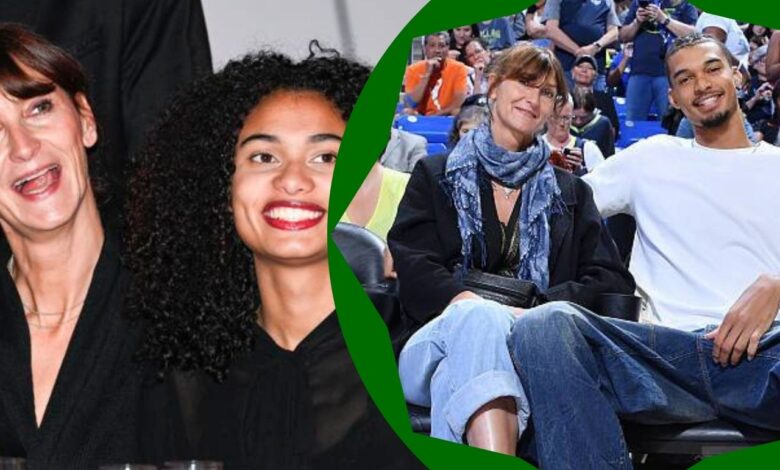
Earlier, at the 2023 NBA Draft — one of the most consequential nights in recent basketball history — Élodie was photographed with her entire family as Victor was selected first overall by the San Antonio Spurs. The image of a mother who had once averaged double figures in a European cup competition now watching her son become the most coveted basketball prospect in the world is one of the most quietly extraordinary images in the story of the Wembanyama family. In April 2026, she made another rare appearance before a Spurs playoff game, once again by her son’s side at one of the most important junctures of his professional career. In May 2025, she was photographed alongside Victor at an WNBA game between the Seattle Storm and the Dallas Wings at the College Park Center in Arlington, Texas — a moment captured and distributed by Getty Images that put her face in front of a global audience for the first time at scale.
These appearances, each rare and carefully chosen, speak to a woman who has never sought the spotlight for herself, but who is always present when it matters most. Élodie de Fautereau moves through the world of her son’s extraordinary fame with the quiet confidence of someone who knows exactly who she is and what she contributed — someone who needs no introduction, no caption, and no validation, because she was building something long before any camera was pointed at her family.
Her Legacy in French Basketball
When the full story of Élodie de Fautereau is examined — not simply as a footnote to Victor Wembanyama’s biography, but as a narrative in its own right — what emerges is the portrait of a woman who devoted her life to basketball in the most complete and generous sense of the word. She played it at the highest level her generation afforded. She competed internationally with the French national team and in European club competition. She averaged double figures in the Ronchetti Cup against continent-level opposition. She then retired from playing and immediately channeled everything she had learned into building the next generation of French basketball talent, not for recognition or financial reward, but because the work genuinely mattered to her.
Her coaching work at the Yvelinois Basketball Academy and at ASVEL has touched hundreds of young players whose names will never appear in an NBA box score or a FIBA tournament bracket. That is not a lesser contribution; in many ways, it is a greater one. The foundation of any sporting ecosystem is built by people who do this quiet, unglamorous work — in modest gymnasiums, with four-year-olds who are more interested in running around than learning pick-and-roll coverage, with teenagers whose attention wanders and whose confidence needs as much coaching as their footwork. Élodie did that work for years, and she did it with the knowledge and dedication of someone who had been to the summit of European competition and returned with everything she had learned to share with those just beginning.
As a French basketball publication noted, her most enduring contribution may be the model she provides for what a full athletic life can look like for a woman in French basketball — from competitive player to national team representative, from European club athlete to respected academy coach, from athlete to parent, from parent to mentor. That full, unbroken arc of commitment to a single sport across an entire adult life is itself a form of greatness, and it deserves to be recognized as such, entirely independently of the famous last name she shares with her extraordinary son.
Read More: Hanspeter Sinner: The Quiet Force Behind a Tennis Champion
Conclusion — The Woman the World Should Know
Élodie de Fautereau is, in the truest sense of the phrase, a self-made basketball legacy. Born into a family that gave her the gift of the game, she took that gift and multiplied it — first through her own professional playing career, then through her years of dedicated coaching, and finally through the extraordinary family she raised alongside Félix Wembanyama. She is a French woman who competed at European level when women’s basketball was still finding its footing on the continental stage. She is a coach who shaped hundreds of young players with the patience and expertise of someone who has lived every lesson she teaches. And she is a mother whose influence is felt every time her son steps onto an NBA court and plays the game with a combination of ferocity, intelligence, and joy that could only have come from a childhood spent in the hands of someone who truly understood what basketball was for.
The world may know the name Wembanyama primarily through Victor’s extraordinary career. But behind every extraordinary career is a story, and behind that story, invariably, is someone who believed first, worked hardest, and loved most unconditionally. For the Wembanyama family, that person is Élodie de Fautereau — and the basketball world owes her a name, a story, and a legacy entirely of her own.