The debate over the best football player of all time has continued for generations. Football fans often disagree because every era has produced special players with different skills, achievements, playing styles and challenges. Some people believe Lionel Messi is the greatest because of his creativity, goals, trophies and World Cup success. Others choose Cristiano Ronaldo because of his extraordinary scoring record, athletic ability and long career at the highest level.
Older football supporters often mention Pelé, the Brazilian legend who won three FIFA World Cups. Diego Maradona is another popular choice because of his unforgettable performances for Argentina and Napoli. Each player has a strong claim, which makes the discussion both exciting and difficult to settle.
Although there may never be one answer accepted by everyone, comparing their careers, major trophies, individual awards, influence and overall football ability can help explain why certain names dominate the conversation.
What Does “Best Football Player of All Time” Really Mean?
Choosing the best football player of all time is not as simple as counting goals or trophies. Football is a team sport, and players perform in different positions, leagues, tactical systems and historical periods. A forward may score hundreds of goals, while a midfielder can control matches through passing, intelligence and creativity.
The standards used in the debate also vary. Some fans value international success, especially the FIFA World Cup. Others focus on club achievements, individual awards, consistency, natural ability or performances in important matches. Longevity is another important factor because maintaining an elite level for 15 or 20 years is extremely difficult.
The quality of opposition and playing conditions must also be considered. Earlier generations played on heavier pitches, with less advanced equipment and fewer protections from referees. Modern footballers face faster tactical systems, intense fitness demands, constant media attention and a packed match schedule. Direct comparisons are therefore difficult.
For most people, the greatest footballer should combine individual brilliance, important trophies, long-term consistency, influence on teammates and unforgettable performances under pressure.
Lionel Messi and His Claim to the GOAT Title
Lionel Messi is widely regarded as the strongest modern candidate for the title of best football player of all time. His career combines goalscoring, passing, dribbling, vision, consistency and major trophies. Unlike many great forwards who are mainly known for scoring, Messi has also spent much of his career creating chances for other players.
Messi developed at Barcelona and became the central figure in one of the most successful periods in the club’s history. His close control, low centre of gravity and quick changes of direction allowed him to move through crowded defensive areas. Even when opponents knew what he intended to do, stopping him remained extremely difficult.
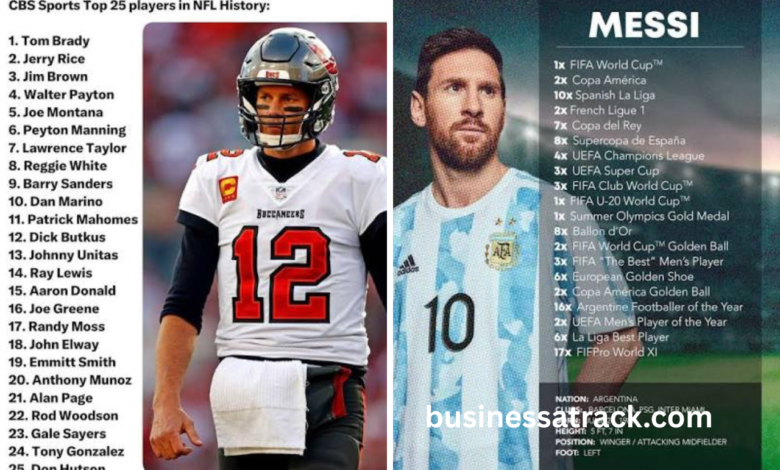
During his Barcelona career, Messi won numerous domestic league titles, Copa del Rey trophies and UEFA Champions League titles. He also became the club’s record goalscorer. His performances were not limited to one or two brilliant seasons. He remained among the world’s best players for more than a decade.
Messi’s eight Ballon d’Or awards strengthened his individual claim. The award is presented to the player judged to have delivered the most outstanding performances during a particular period. Winning it eight times shows the level of dominance and consistency he achieved.
For many years, the main argument against Messi was his lack of a senior international trophy. That criticism weakened when Argentina won the Copa América and disappeared almost completely after Messi led his country to the 2022 FIFA World Cup title.
The World Cup victory was highly important to his legacy. Messi scored, created chances and delivered under pressure throughout the tournament. Argentina’s success gave him the one major trophy that had previously separated him from players such as Pelé and Maradona.
Messi’s greatness also comes from the balance in his game. He can operate as a winger, attacking midfielder, false nine or central creator. He does not depend only on speed or strength. His intelligence, timing and awareness allow him to influence matches even as his physical abilities change with age.
Cristiano Ronaldo and His Extraordinary Career
Cristiano Ronaldo is one of the most successful and recognisable footballers in history. His supporters argue that his goals, mentality, fitness, leadership and success across several countries make him the best football player of all time.
Ronaldo began his elite career as a skilful winger but developed into one of football’s most dangerous goalscorers. His transformation demonstrated his ability to adapt. During his early years, he relied heavily on speed, dribbling and tricks. Later, he became more direct, improved his movement inside the penalty area and turned into a powerful centre-forward.
He achieved major success with Manchester United, Real Madrid and Juventus. Winning league titles in England, Spain and Italy showed that he could perform in different football cultures and tactical systems. His time at Real Madrid was especially productive, as he became the club’s leading goalscorer and delivered many memorable performances in the UEFA Champions League.
Ronaldo’s Champions League record is central to his legacy. He repeatedly scored in knockout matches and finals, earning a reputation as a player who performs in high-pressure situations. His heading, finishing with both feet, penalty-taking and movement made him a complete scorer.
Internationally, Ronaldo helped Portugal win UEFA Euro 2016 and the UEFA Nations League. Portugal had never won a major senior men’s international tournament before Euro 2016, making the achievement historically important.
Ronaldo has also remained competitive for an unusually long period. His commitment to training, recovery and fitness has allowed him to continue scoring well beyond the age when many forwards decline. His career is often used as an example of discipline and professional ambition.
Critics may argue that Messi is the more natural playmaker, but Ronaldo’s supporters point to his adaptability, athleticism and record-breaking goals. His achievements ensure that any serious debate about the greatest footballer must include him.
Pelé and the Importance of Three World Cups
Pelé remains one of the most important names in football history. He became a global star at a time when football was rapidly expanding through international television coverage. His performances for Brazil helped shape the image of beautiful, attacking football.
Pelé made his World Cup debut as a teenager and played a major role in Brazil’s victory in 1958. His youth, confidence and technical quality captured global attention. Brazil later won the tournament again in 1962 and 1970, making Pelé the only player associated with three World Cup-winning squads.
The 1970 Brazilian team is often considered one of the greatest national teams ever assembled. Pelé was no longer simply a goalscorer at that stage. He had developed into an intelligent creator who could connect midfield and attack, provide assists and control the rhythm of forward play.
Pelé spent most of his club career with Santos, where he won major domestic and international honours. Santos also travelled widely, allowing fans in different countries to see him perform. This helped turn Pelé into one of football’s first truly global superstars.
Goal statistics from Pelé’s era can be difficult to compare with modern records because some totals include friendly and exhibition matches. However, there is no doubt that he scored hundreds of official goals and was a highly productive forward.
His supporters argue that three World Cups represent an achievement unmatched by Messi, Ronaldo or Maradona. Critics respond that Brazil had outstanding teams and that modern club football provides a larger number of high-level matches. Even so, Pelé’s historical influence, international success and complete attacking ability make him a permanent part of the GOAT debate.
Diego Maradona and the Greatest Individual Peak
Diego Maradona’s claim to being the best football player of all time is built less on longevity and more on his astonishing peak. At his best, Maradona could dominate matches through dribbling, passing, creativity, balance and personality.
The 1986 FIFA World Cup is the strongest evidence supporting his case. Maradona led Argentina to the title and produced several iconic moments. His performance against England included both the controversial “Hand of God” goal and the famous “Goal of the Century,” in which he dribbled past several opponents before scoring.
Throughout that tournament, Maradona carried much of Argentina’s attacking responsibility. He created chances, scored important goals and attracted several defenders whenever he received the ball. Many historians view his 1986 World Cup campaign as one of the greatest individual tournament performances in football history.
Maradona also achieved remarkable success with Napoli. Before his arrival, the Italian club did not possess the same status as the traditional powers from northern Italy. Maradona helped Napoli win Serie A titles and became a cultural hero in the city.
His success at Napoli strengthened his reputation because Serie A was considered one of the most tactically demanding and defensively strong leagues in the world. Maradona regularly faced aggressive marking and limited space, yet still produced moments of brilliance.
His career also contained controversy, fitness problems and periods of instability. These issues prevented him from maintaining the same level for as long as Messi or Ronaldo. Nevertheless, his supporters believe that no player has ever reached a higher level of individual influence than Maradona at his peak.
Comparing Messi and Cristiano Ronaldo
The Messi versus Ronaldo debate has defined modern football. Both players delivered extraordinary numbers over a long period, often pushing each other to achieve even more.
Messi is generally considered the better dribbler and playmaker. He can drop into midfield, control possession, make defence-splitting passes and score from open play or set pieces. His football often appears natural and effortless.
Ronaldo is usually viewed as the more powerful athlete and traditional goalscorer. He has exceptional movement, heading ability, strength and determination. He became successful in multiple leagues and adapted his style as he aged.
Messi won more Ballon d’Or awards and added the World Cup to his career achievements. Ronaldo built one of the greatest Champions League records and became one of the leading international goalscorers in football history.
The choice between them often depends on personal preference. Fans who admire creativity and complete attacking control usually favour Messi. Those who value power, mentality, adaptability and relentless scoring often choose Ronaldo.
Comparing Modern Players with Pelé and Maradona
Comparing modern footballers with legends from previous generations is challenging. Pelé and Maradona played under different rules, travelled under more difficult conditions and faced a more physical style of defending. They also had access to less advanced medical care and training technology.
Messi and Ronaldo benefited from modern sports science, better pitches, improved footwear and detailed tactical preparation. However, modern football also demands greater speed, more intense pressing and year-round physical conditioning.
Another difficulty is the difference in available footage and statistics. Almost every modern match is recorded and analysed in detail. Earlier players are often remembered through highlights, tournament performances and historical accounts. This can create both exaggeration and unfair dismissal.
The strongest approach is to judge each player within his own era. Pelé dominated international football and became a global icon. Maradona produced one of the greatest individual World Cup campaigns. Messi combined creativity, trophies and consistency at an unmatched level. Ronaldo redefined goalscoring longevity and athletic excellence.
Other Players Who Belong in the Conversation
Although Messi, Ronaldo, Pelé and Maradona receive the most attention, many other legends deserve recognition.
Johan Cruyff transformed football both as a player and as a thinker. His intelligence, technique and understanding of space influenced the development of Total Football and later shaped modern attacking systems.
Franz Beckenbauer changed how defenders were viewed. Playing as a sweeper, he combined defensive leadership with passing and control. He won major honours for both club and country.
Zinedine Zidane was known for elegance, close control and performances in major matches. He won the World Cup with France in 1998 and later delivered unforgettable moments at club level.
Ronaldo Nazário was among the most dangerous strikers football has seen. Injuries affected his career, but at his peak he combined speed, strength, dribbling and finishing in a rare way.
Alfredo Di Stéfano, Ferenc Puskás, George Best, Michel Platini, Ronaldinho and Paolo Maldini are also regularly included in discussions about football’s greatest players.
The Role of the World Cup in the GOAT Debate
The FIFA World Cup carries enormous importance because it is football’s biggest international competition. Success in the tournament can strongly shape a player’s historical reputation.
Pelé’s three World Cups are a major reason he remains near the top of all-time rankings. Maradona’s 1986 performance became the central part of his legacy. Messi’s 2022 victory completed his collection of major achievements.
Ronaldo never won the World Cup, but judging a player only by this tournament can be unfair. A footballer cannot choose the strength of his national team, and the competition takes place only once every four years.
Club football provides a larger sample of matches and may offer a better measure of long-term consistency. The most balanced judgment should therefore consider both club and international football.
Individual Awards and Their Limitations
The Ballon d’Or is frequently used to compare great players. Messi’s eight awards and Ronaldo’s five show how strongly they dominated their era.
However, individual awards also have limitations. Voting can be influenced by major tournaments, media narratives, team success and personal preference. Earlier non-European players were not always eligible under the award’s original rules, making direct historical comparisons difficult.
Pelé and Maradona played during periods when the Ballon d’Or did not operate under the same global eligibility system used today. Their lower official totals should not therefore be treated as proof that they were less talented.
Awards are useful evidence, but they should not be the only method used to identify the greatest player.
Goals, Assists and the Problem with Statistics
Statistics are central to modern football discussions. Goals, assists, appearances and trophies allow fans to compare careers more clearly. Ronaldo’s goalscoring records and Messi’s combination of goals and assists are major parts of their GOAT arguments.
However, football cannot be fully explained through numbers. Statistics may not capture movement that creates space, control of match tempo, leadership, defensive contribution or technical brilliance.
Different leagues and eras also vary in quality and style. Some competitions are more defensive, while others produce higher-scoring matches. The number of fixtures played in a season has also changed over time.
Statistics are valuable, but they should be combined with match performances, context and overall influence.
Influence Beyond the Football Pitch
The greatest footballers influence more than results. They inspire children, change playing styles, increase the popularity of clubs and shape the image of the sport.
Pelé helped football become a truly global game. Maradona became a symbol of hope and identity in Argentina and Naples. Ronaldo inspired millions through his fitness, ambition and determination. Messi influenced young players through his technique, humility and creative approach.
Their popularity also transformed football commercially. Shirt sales, sponsorships, television audiences and social media engagement increased around their careers.
A player’s cultural influence does not automatically make him the greatest, but it adds an important dimension to his legacy.
So, Who Is the Best Football Player of All Time?
Based on complete football ability, consistency, individual awards, club success, international achievements and longevity, Lionel Messi has the strongest overall claim to being the best football player of all time.
His 2022 World Cup victory was especially important because it answered the main criticism previously used against him. He has won at club and international level while producing elite goalscoring and playmaking numbers over many seasons.
Cristiano Ronaldo remains extremely close because of his scoring records, Champions League success, international trophies and remarkable longevity. Pelé’s three World Cups remain unmatched, while Maradona’s peak may still be the most powerful example of one player dominating a major tournament.
The answer will always contain some personal opinion. A Brazilian supporter may choose Pelé, an Argentine fan may favour Messi or Maradona, and many Portuguese supporters will continue to defend Ronaldo.
Conclusion
The search for the best football player of all time is one of sport’s greatest debates. Lionel Messi, Cristiano Ronaldo, Pelé and Diego Maradona each represent a different form of football greatness.
Messi offers the most balanced career, combining goals, assists, trophies, individual awards and a World Cup. Ronaldo represents determination, athletic power, goalscoring and longevity. Pelé symbolises World Cup dominance and football’s global rise. Maradona represents individual genius and the ability to inspire teams beyond expectations.
For the modern era, Messi is the most convincing overall choice. However, football history is too rich to reduce greatness to one name without recognising the achievements of the other legends. The debate continues because each player gave the game something unique, unforgettable and almost impossible to repeat.
You may also read : Education and Academic Qualifications