Lewis Hine was one of the most influential documentary photographers in American history. His photographs did far more than record people, buildings and workplaces. They exposed injustice, challenged social attitudes and gave a visible identity to children, immigrants and labourers who were often ignored by society.
Best known for documenting child labour in the United States, Hine believed that photography could become a powerful instrument for reform. His images showed young children working inside dangerous factories, coal mines, textile mills and canneries. By combining emotional photographs with carefully recorded information, he helped reform organisations demonstrate the human cost of industrial growth.
Hine also photographed immigrants arriving at Ellis Island, workers constructing the Empire State Building and communities affected by the First World War. Although he struggled financially during the final years of his life, his work later became recognised as a foundation of modern documentary photography and socially responsible photojournalism.
Who Was Lewis Hine?
Lewis Wickes Hine was an American photographer, sociologist, teacher and social reformer. He was born on 26 September 1874 in Oshkosh, Wisconsin, and died on 3 November 1940 at the age of 66.
Hine became famous because he used photography to investigate difficult social conditions. Unlike photographers who focused mainly on wealthy families, attractive landscapes or formal portraits, Hine turned his camera towards ordinary people. He photographed factory workers, immigrants, children, miners and construction labourers.
His work was guided by a strong belief that photographs could influence public opinion. He understood that many Americans had little knowledge of the conditions inside factories and mines. By bringing those hidden realities into public view, he hoped to encourage political action and social responsibility.
Hine was not simply trying to create shocking images. He wanted viewers to recognise the dignity, intelligence and individuality of the people he photographed. His subjects were often poor or vulnerable, but he avoided presenting them as meaningless symbols. Instead, he showed them as real human beings with names, families, struggles and ambitions.
Lewis Hine’s Early Life
Lewis Hine was born into a working family in Wisconsin. His father died when Hine was still young, leaving the family in a difficult financial situation. As a result, Hine had to work in demanding jobs to help support his mother and sisters.
These early experiences gave him direct knowledge of physical labour, low wages and economic insecurity. He understood that work could provide dignity and independence, but he also recognised that workers could be exploited when employers faced weak regulation.
His own experience of industrial work later influenced his photography. When he photographed children and labourers, he did not approach them as distant subjects. He understood the exhaustion, pressure and vulnerability associated with difficult working conditions.
Hine eventually continued his education and studied subjects connected with sociology, education and social welfare. His intellectual development helped shape the research-based approach he later used in photography. He did not treat photographs as isolated images. He connected them with social evidence, personal testimony and detailed observations.
Education and Early Teaching Career
Hine studied at institutions including the University of Chicago, Columbia University and New York University. His education introduced him to sociology and reform movements that examined poverty, working conditions, immigration and urban life.
He later became a teacher at the Ethical Culture School in New York City. While teaching, he began to use photography as an educational method. He believed that students could understand society more deeply by observing real people and real conditions.
Photography gave Hine a new way to connect education with social investigation. Instead of relying only on written reports, he could present visual evidence. A photograph allowed viewers to see expressions, environments, machinery and clothing. These details could make distant social problems feel immediate and personal.
His teaching background remained important throughout his career. Hine’s photographs were designed not only to document but also to educate. He wanted audiences to examine what they were seeing and consider their own responsibility towards vulnerable members of society.
Ellis Island and the Photography of Immigrants
Beginning in the early twentieth century, Hine photographed immigrants arriving at Ellis Island in New York Harbor. Ellis Island was an important processing centre for people entering the United States, and many of the newcomers arrived from Europe after difficult journeys.
At the time, immigrants were often described negatively in political debate and popular newspapers. They were sometimes presented as dangerous, uneducated or unwilling to become part of American society.
Hine’s photographs challenged these stereotypes. He created respectful portraits of individuals and families from different national and cultural backgrounds. His images showed parents protecting children, workers carrying their belongings and families preparing to begin uncertain new lives.
Rather than portraying immigrants as an anonymous crowd, Hine focused on their individual humanity. Their clothing and expressions reflected different cultures and personal experiences, but the photographs also showed common emotions such as hope, anxiety, exhaustion and determination.
The Ellis Island project helped establish Hine’s photographic approach. He learned that images could oppose prejudice by giving viewers a direct human connection with people they might otherwise misunderstand.
Lewis Hine and the National Child Labor Committee
Lewis Hine’s most important professional relationship was with the National Child Labor Committee. The organisation campaigned against the employment of young children in dangerous and exploitative workplaces.
Hine began working as an investigative photographer for the committee in 1908. Over the following years, he travelled throughout the United States to document child labour in factories, farms, mines, canneries and street trades.
His assignments were difficult and sometimes dangerous. Many employers did not want the public to see children working inside their businesses. Factory owners understood that such photographs could create criticism and support demands for regulation.
To gain access, Hine occasionally presented himself as an insurance representative, industrial photographer, postcard seller or religious worker. These identities allowed him to enter workplaces where reform investigators might otherwise have been rejected.
When employers refused access, Hine photographed children outside factory gates before or after their shifts. He also interviewed them discreetly and recorded important details about their lives.
How Lewis Hine Documented Child Labour
Hine’s photographs were especially powerful because they were supported by written information. He often recorded the child’s name, age, workplace, working hours and family circumstances.
In some cases, children or employers gave inaccurate ages because very young workers were not legally permitted to perform certain jobs. Hine therefore used visual comparisons and other methods to estimate age.
He understood that reform campaigns required reliable evidence. A photograph could create emotional concern, but detailed captions made it harder for employers or politicians to dismiss the image as an unusual case.
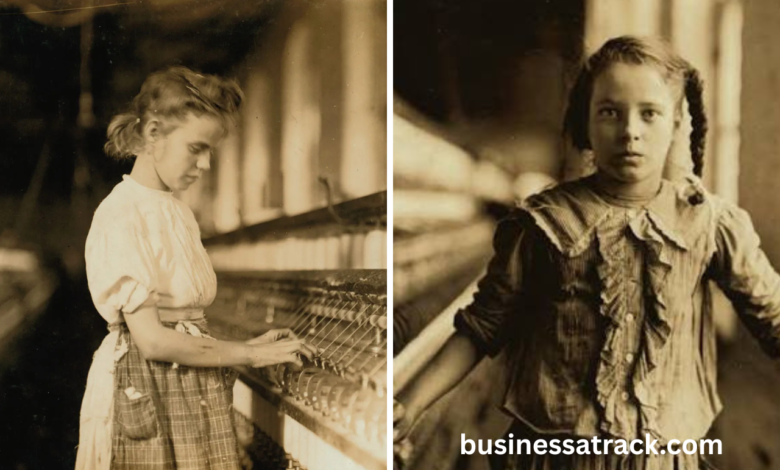
Hine photographed children working beside large and dangerous machinery. He documented young miners covered in coal dust, boys working in glass factories and girls operating spinning machines inside textile mills.
He also photographed news sellers, agricultural workers, oyster shuckers and children employed in home-based manufacturing. His work demonstrated that child labour was not restricted to one industry or region. It was deeply connected to the wider American economy.
Working Conditions Shown in Hine’s Photographs
The children in Hine’s images often worked for long hours in unsafe environments. Textile mills contained rapidly moving machinery that could cause serious injuries. Mines exposed boys to dust, darkness and physical strain. Glass factories involved dangerous heat and sharp materials.
Many children worked because their families depended on their income. Poverty made it difficult for parents to remove children from employment, even when the work threatened their health or education.
Hine’s photographs revealed the conflict between industrial profit and childhood development. Young workers were expected to perform adult responsibilities before they had completed their education or experienced a secure childhood.
The emotional effect of the images came partly from visual contrast. Small children stood beside enormous machines. Their height, clothing and tired expressions showed how young they were, while the industrial environment demonstrated the scale of the danger surrounding them.
Hine’s photographs also recorded the social consequences of child labour. Children who worked long shifts had limited access to education. Physical injuries and chronic health problems could affect them throughout adulthood.
The Role of Lewis Hine’s Photography in Social Reform
Hine’s photographs were used in reports, exhibitions, newspapers, lectures and campaign materials. Reformers presented them to audiences who might never have entered a factory or mining community.
The images helped transform child labour from an abstract policy issue into a human story. Instead of hearing only statistics, viewers saw individual children whose lives were shaped by industrial exploitation.
Hine’s work contributed to a wider national movement for labour reform. However, he was not the only person responsible for changing child labour law. Journalists, campaigners, social workers, politicians and local organisations also played essential roles.
The Keating–Owen Child Labor Act was passed in 1916, although it was later declared unconstitutional. Reform efforts continued through state legislation and further national campaigns.
Comprehensive federal protections were eventually strengthened through the Fair Labor Standards Act of 1938. This law introduced important rules concerning minimum wages, working hours and the employment of children.
Hine’s greatest contribution was providing persuasive evidence that reformers could use. His photographs made it more difficult for society to ignore the effects of child labour.
Lewis Hine’s Photography Style
Hine described his work as “photo-interpretation.” He recognised that a photographer could never be entirely neutral because every image involved choices. The photographer selected the subject, location, angle and moment.
However, Hine believed strongly in honesty. He opposed misleading captions, unnecessary retouching and staged deception. His intention was to interpret reality without falsifying it.
His compositions were carefully organised. He often positioned workers in ways that revealed both their humanity and their working environment. Machinery, buildings and tools provided context, while facial expressions created emotional connection.
Hine’s photographs could be visually beautiful even when the subject was painful. This combination of artistic composition and social evidence helped documentary photography gain recognition as an important form of communication.
He also treated workers with respect. While some reform photography reduced poor people to examples of suffering, Hine often showed strength, skill and determination alongside hardship.
Lewis Hine During the First World War
During and after the First World War, Hine travelled in Europe on assignments connected with the American Red Cross. He documented refugees, displaced families, wounded individuals and reconstruction activities.
The war expanded the geographical and emotional range of his work. He photographed people whose homes and communities had been damaged by conflict.
As in his earlier projects, Hine focused on individuals rather than presenting the war only through military activity. His images revealed the impact of conflict on ordinary civilians.
He photographed families coping with uncertainty and communities attempting to rebuild. These photographs continued his wider interest in how large political and economic forces affected individual lives.
The Empire State Building Photographs
One of Lewis Hine’s most celebrated later projects involved documenting the construction of the Empire State Building in New York City.
The skyscraper was constructed during a period of rapid technological and architectural development. Hine photographed the labourers who worked at extraordinary heights to assemble its steel structure.
His images show workers balancing on beams, lifting materials and operating equipment far above the city streets. The photographs captured both the danger of the work and the skill required to perform it.
For some images, Hine used a specially designed basket that was suspended high above the city. This allowed him to photograph workers from unusual and dramatic viewpoints.
The Empire State Building project differed from his child-labour photographs. Instead of concentrating mainly on exploitation, Hine celebrated the expertise and courage of adult industrial workers.
He wanted viewers to understand that great buildings were created not only by architects and business leaders but also by labourers whose physical work made construction possible.
Men at Work
Hine published selected industrial and construction photographs in his 1932 book, Men at Work. The publication presented labour as an essential force in modern society.
The book reflected Hine’s respect for workers. He showed people controlling powerful machines, constructing buildings and contributing to industrial development.
Although modern technology was changing workplaces, Hine emphasised that human knowledge and effort remained central. Machines did not operate independently. They required workers with training, judgment and courage.
Men at Work became an important part of Hine’s legacy because it presented workers as creators rather than invisible employees. The book celebrated the relationship between human labour and technological achievement.
Was Lewis Hine the Photographer of Lunch Atop a Skyscraper?
Lewis Hine is sometimes incorrectly connected with the famous photograph commonly known as Lunch Atop a Skyscraper. The image shows construction workers eating lunch while sitting on a steel beam high above New York City.
However, the photograph was taken during the construction of Rockefeller Center, not the Empire State Building. Its exact photographer has remained uncertain.
Hine’s connection with skyscraper photography may explain the confusion. His photographs of Empire State Building workers feature similar themes, including height, steel beams and construction labour.
Although he did not create Lunch Atop a Skyscraper, his authentic photographs of high-rise workers remain among the most important records of American construction history.
Financial Difficulties and Later Life
Despite the importance of his work, Hine faced serious professional and financial difficulties during the 1930s.
Photography was changing, and organisations that had once employed him no longer provided consistent assignments. Public interest also shifted towards newer styles of documentary photography.
Hine participated in projects related to industry, unemployment and social conditions. He also worked as chief photographer for the National Research Project of the Works Progress Administration.
However, these opportunities did not provide long-term financial security. He struggled to find regular employment and eventually lost his home.
His later difficulties reveal the painful difference between cultural importance and financial success. Hine had helped reshape public understanding of labour and childhood, yet he was not fully recognised or supported during his final years.
Photographer Berenice Abbott and critic Elizabeth McCausland helped organise a retrospective exhibition of his work in 1939. This recognition came shortly before his death.
Lewis Hine died in 1940 following an operation. At the time, his reputation had declined, but later generations rediscovered the historical and artistic importance of his archive.
Lewis Hine’s Wife and Family
Lewis Hine married Sara Ann Rich in 1904. The couple had one son, Corydon Lewis Hine.
Hine’s family life remained less publicly documented than his professional work. His reputation is primarily connected with his photography, teaching and social reform activities.
The demands of travel and investigative photography would have affected his domestic life. His work for the National Child Labor Committee required him to travel across different regions of the United States, often under difficult conditions.
Although his wife and son were not central public figures, they formed part of the personal life behind his demanding career.
Famous Lewis Hine Photographs
Lewis Hine created thousands of photographs during his career. Some of his most recognisable images show children working in cotton mills, factories and mines.
Sadie Pfeifer became one of the children associated with Hine’s textile-mill photography. Her small figure standing near industrial machinery became a powerful visual symbol of child labour.
Addie Card was another young mill worker photographed by Hine. Her portrait later attracted renewed historical interest because researchers investigated her life beyond the original photograph.
Other well-known subjects include breaker boys who separated coal, young newspaper sellers and children working inside glass factories.
Hine’s Empire State Building photographs include images often identified by titles such as Icarus Atop the Empire State Building and Raising the Mast. These photographs celebrate workers performing dangerous tasks against the dramatic background of New York City.
His image sometimes known as Powerhouse Mechanic shows a worker physically connected with industrial machinery. The photograph has become an important representation of labour and modern technology.
Hine’s Importance to Documentary Photography
Before photographers such as Hine, photography was often viewed mainly as portraiture, scientific evidence or artistic entertainment.
Hine demonstrated that a photographer could investigate society. His work connected visual storytelling with journalism, sociology and political activism.
He influenced later documentary photographers who recorded poverty, migration, war and industrial change. His methods can be seen in modern photojournalism, where images are often supported by captions, interviews and contextual reporting.
Hine also established an ethical model. He tried to preserve the dignity of his subjects, even while revealing their vulnerability.
His photographs remind modern audiences that documentary work involves responsibility. The photographer must consider accuracy, context and the possible effect of an image on the person being photographed.
Lewis Hine’s Legacy
Lewis Hine is now recognised as one of the most important American photographers of the twentieth century.
His child-labour photographs remain essential records of industrial history. They show how economic growth could depend on the labour of vulnerable children.
His Ellis Island images preserve the experiences of immigrants arriving in the United States during a major period of migration. His war photographs reveal the effect of international conflict on civilians, while his construction images celebrate the courage of industrial workers.
Major collections of Hine’s work are preserved by institutions including the Library of Congress, the Smithsonian, the National Archives and the International Center of Photography.
The National Child Labor Committee collection held by the Library of Congress contains thousands of prints and hundreds of glass negatives. These materials allow researchers to study individual photographs alongside Hine’s detailed captions.
His images are now used in museums, classrooms, historical studies and exhibitions around the world. They continue to influence discussions about labour rights, workplace safety, immigration and social inequality.
Why Lewis Hine Still Matters Today
Lewis Hine’s work remains relevant because child labour and worker exploitation have not completely disappeared.
In many countries, children continue to work in agriculture, manufacturing, mining and informal industries. Modern supply chains can make it difficult for consumers to know where products come from or who produced them.
Hine’s photography encourages people to look beyond finished products and consider the workers behind them. His images demonstrate that economic progress should not be separated from human welfare.
His work is also important in the age of digital media. Photographs can spread rapidly, but images can also be manipulated or removed from context.
Hine’s careful combination of visual evidence and written documentation offers a valuable model for responsible journalism. He showed that emotional power should be supported by accurate information.
Conclusion
Lewis Hine transformed photography into a tool for investigation, education and social reform. Through his camera, he exposed child labour, challenged prejudice against immigrants and celebrated the contribution of industrial workers.
His photographs were powerful because they combined artistic skill with factual evidence. He did not simply show suffering. He recorded names, ages, workplaces and personal circumstances, allowing viewers to understand the wider systems behind individual experiences.
Although Hine experienced poverty and professional neglect near the end of his life, his reputation later grew significantly. Today, he is remembered as a pioneer of documentary photography and an important advocate for human dignity.
His lasting achievement was making hidden people visible. The children, immigrants and workers in his photographs were no longer anonymous figures within industrial history. Through Lewis Hine’s work, their faces, struggles and contributions became part of the permanent historical record.
You may also read : Her Career as an Aeroflot Flight Attendant