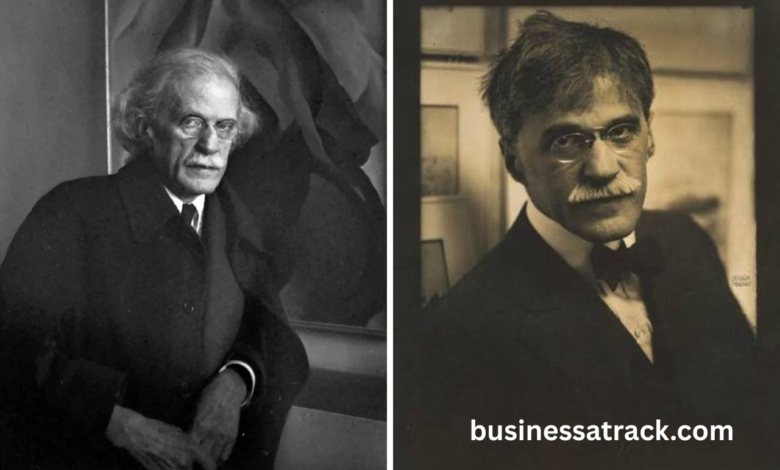
Alfred Stieglitz stands as one of the most influential figures in the history of photography and modern art. His importance does not lie only in the images he created, but in the way he fundamentally reshaped the cultural status of photography itself. Before Stieglitz, photography was widely treated as a mechanical craft—useful for documentation, portraiture, and reproduction, but rarely considered equal to painting or sculpture. Stieglitz challenged this belief throughout his life and succeeded in elevating photography into the realm of fine art.
He was not a passive artist. He was an editor, publisher, curator, critic, and cultural strategist who built institutions that changed artistic history. Through journals like Camera Work, movements like Photo-Secession, and galleries such as 291, he created a platform where photography and modern art could be seen, discussed, and respected at the highest level. His legacy extends beyond photography into the broader development of modern art in America.
Early Life and Intellectual Formation
Alfred Stieglitz was born in 1864 in Hoboken, New Jersey, into a German-Jewish family that valued education, discipline, and intellectual development. His early life was shaped by cultural mobility, as his family spent significant time in Europe during his youth. This exposure to European artistic traditions would later become crucial in shaping his artistic sensibility.
He studied mechanical engineering in Berlin, where he was introduced to scientific methods, optics, and chemistry. Although his formal training was technical, his interests quickly expanded into photography, which at that time was deeply connected to scientific experimentation. Under the guidance of photographic scientists and educators in Europe, he learned about exposure, development processes, and the chemical foundations of image-making.
This combination of scientific discipline and artistic curiosity defined Stieglitz’s entire career. Unlike many photographers of his time, he understood photography both as a technical process and as a potential expressive medium. This dual understanding allowed him to push boundaries that others did not even recognize existed.
Early Photographic Work and European Influence
During his early photographic years in Europe, Stieglitz produced images that reflected both technical precision and artistic experimentation. He was particularly drawn to landscapes, rural scenes, and urban environments affected by weather and atmospheric conditions. Snow, rain, fog, and steam became recurring elements in his compositions.
These environmental conditions were not incidental. Stieglitz used them deliberately to demonstrate that photography could capture mood and emotion, not just physical reality. A street covered in snow or a train emerging from steam became, in his vision, more than documentation—it became visual poetry.
He also participated in photographic competitions and exhibitions across Europe, gaining recognition for his technical excellence. However, even in these early years, he was dissatisfied with the way photography was perceived. He believed it deserved equal status with painting and sculpture, a radical idea at the time.
Return to America and the Birth of a Mission
When Stieglitz returned to the United States in the 1890s, he entered a photographic culture that was still developing its identity. Photography in America was widely practiced but not widely respected as an art form. Amateur camera clubs were growing, but the idea of photography as high art was still controversial.
Stieglitz immediately began working to change this perception. He joined photographic societies, wrote critical essays, organized exhibitions, and promoted a higher standard of photographic practice. He argued that photography required not only technical skill but also artistic vision.
His belief was simple but revolutionary: a photograph should not merely reproduce reality—it should interpret it. This principle became the foundation of his entire career.
Camera Notes and the Rise of Editorial Power
One of Stieglitz’s most important contributions was his role as editor of Camera Notes, a photographic journal that became a platform for serious artistic discussion. Through this publication, he introduced a new level of intellectual rigor to photography.
He selected images carefully, often rejecting works that did not meet his artistic standards. This created tension within the photographic community, but it also raised expectations about what photography could achieve. Under his leadership, Camera Notes became more than a magazine—it became a statement about photographic excellence.
During this period, Stieglitz developed his belief that photography needed a cultural infrastructure. It was not enough to create images; there had to be institutions that validated and preserved them. This insight would later lead to his most significant achievements.
The Photo-Secession Movement: Breaking Away from Tradition
In 1902, Stieglitz founded the Photo-Secession movement, a group of photographers who believed that photography deserved recognition as a fine art. The name itself suggested separation from conventional photographic practice.
The movement emphasized artistic control, craftsmanship, and emotional expression. Members often used soft focus, special printing techniques, and carefully composed scenes to create images that resembled paintings in mood and atmosphere. This approach, later known as Pictorialism, dominated early artistic photography.
However, Stieglitz’s vision was more complex than simple imitation of painting. He believed photography had its own artistic language. While he initially supported Pictorialism, he gradually moved toward a more direct and modern style that emphasized clarity and structure.
Camera Work: The Magazine That Defined an Era
In 1903, Stieglitz launched Camera Work, one of the most important photographic journals ever produced. It was not merely a publication; it was a cultural project. Every issue was carefully designed, printed, and curated with extraordinary attention to detail.
Camera Work featured high-quality photographic reproductions, critical essays, and writings on modern art. It became a bridge between photography and the broader modernist movement. Through this journal, Stieglitz introduced American audiences to European avant-garde artists and new ideas about visual expression.
The publication helped establish photography as a serious intellectual and artistic discipline. It also demonstrated Stieglitz’s belief that photography needed critical discourse, not just images.
291 Gallery: The Birthplace of American Modernism
In 1905, Stieglitz opened a small gallery at 291 Fifth Avenue in New York. Known simply as “291,” this space became one of the most influential art galleries in American history.
Initially focused on photography, the gallery soon expanded to include painting, sculpture, and experimental modern art. Stieglitz and his collaborators introduced American audiences to European artists who were largely unknown in the United States at the time.
Artists such as Rodin, Matisse, Cézanne, Picasso, and Brancusi were exhibited in America for the first time through 291. This was a cultural revolution. At a time when American art institutions were conservative and cautious, Stieglitz was introducing radical new forms of expression.
291 became a meeting point for artists, writers, and intellectuals who were shaping modern art. It was not just a gallery—it was a cultural laboratory.
The Evolution Toward Modern Photography
As Stieglitz engaged more deeply with modern art, his own photography began to change. He moved away from heavily manipulated pictorial styles and toward a clearer, more direct photographic approach.
This shift reflected broader changes in modern art, particularly the influence of artists like Cézanne, who emphasized structure, geometry, and perception. Stieglitz began to see photography not as imitation of painting, but as a unique medium with its own visual logic.
His urban photographs of New York, including street scenes, architecture, and industrial environments, reflect this transition. They capture modern life with precision while maintaining emotional depth.
The Steerage: A Defining Masterpiece
One of Stieglitz’s most famous photographs, The Steerage, represents a turning point in his artistic vision. Created during a transatlantic voyage, the image depicts passengers on a ship divided into upper and lower sections.
At first glance, it is a documentary image of travel and social conditions. However, its deeper significance lies in its formal composition. The arrangement of lines, shapes, and human figures creates a powerful geometric structure.
This photograph marks Stieglitz’s full transition into modernist thinking. It combines social observation with abstract composition, demonstrating that photography can operate on multiple intellectual and aesthetic levels simultaneously.
Georgia O’Keeffe: Art, Love, and Collaboration
One of the most significant relationships in Stieglitz’s life was with the artist Georgia O’Keeffe. Their connection began through artistic admiration and evolved into a complex personal and creative partnership.
Stieglitz photographed O’Keeffe extensively, producing hundreds of portraits over several decades. These images explore identity, emotion, and presence in ways that go beyond traditional portraiture.
Their relationship also played a crucial role in shaping American modernism. Stieglitz promoted O’Keeffe’s paintings, exhibited her work, and helped establish her reputation as one of the most important artists of her time.
Their collaboration represents a fusion of photography and painting, personal life and artistic vision, intimacy and public expression.
The Equivalents: Photography as Pure Emotion
In his later years, Stieglitz created a series of cloud photographs known as Equivalents. These images marked one of the earliest explorations of abstract photography.
In these works, the subject is not important in a literal sense. Clouds become visual symbols of emotional states. The sky becomes a space for psychological expression rather than physical description.
This idea was revolutionary. It suggested that photography could express feelings directly, without relying on recognizable subjects. In this sense, Stieglitz anticipated many developments in abstract art and photography.
Later Years and Continued Influence
In his later life, Stieglitz continued to support modern artists through smaller galleries and private exhibitions. He remained deeply committed to the idea that art should reflect contemporary life and personal vision.
Even as new artistic movements emerged, his influence remained strong. Younger photographers and artists continued to study his work and adopt his ideas about composition, meaning, and artistic integrity.
His later years were quieter, but his intellectual influence never diminished. He had already reshaped the foundations of modern photography.
Legacy: The Father of Modern Photography
Alfred Stieglitz’s legacy is immense and multifaceted. He is remembered not only as a photographer but as a cultural architect who helped define modern art in America.
He demonstrated that photography could be intellectually serious, emotionally expressive, and artistically sophisticated. He built institutions that supported artistic innovation and introduced audiences to revolutionary ideas in visual culture.
His influence extends into contemporary photography, museum culture, and modern art theory. Every serious discussion about photography as art inevitably traces back to his work.
Conclusion: A New Way of Seeing
Alfred Stieglitz transformed photography from a mechanical process into a language of modern expression. His life’s work was not limited to images but extended to ideas, institutions, and cultural transformation.
He taught the world that photography is not just about capturing what is visible—it is about interpreting what is felt. Through his photographs, publications, galleries, and artistic advocacy, he permanently changed how we understand images.
you may also read :Mary Astor’s Diary and Writing Style